

Custom Homes in Wimberley — A Valley with Its Own Identity
Forty-five miles southwest of Austin in the Blanco River valley. Cypress Creek, Jacob’s Well, the Wimberley Square — and a community of artists, musicians, and independent spirits who chose this place for what it is.
Where Cypress Creek Meets the Blanco
Wimberley sits in a valley. That distinction matters. Most of Paradise’s Hill Country communities are defined by ridgelines, hilltops, and elevation — the terrain rises and falls, and the homes are positioned to take advantage of the views from above. Wimberley reverses that relationship. The community occupies the Blanco River valley at the point where Cypress Creek flows into the Blanco, and the terrain wraps around rather than falling away. The bald cypress trees along the creek banks, the pecan canopy in the bottomland, and the limestone hills rising on every side create a landscape that feels sheltered and enclosed — intimate in a way that the wide-open ridgetop communities do not.
Jacob’s Well, a deep artesian spring that serves as the headwaters of Cypress Creek, is one of the most recognized natural features in the Hill Country. Blue Hole, a spring-fed swimming hole shaded by towering bald cypress, has drawn visitors since the 1920s. The Blanco River itself — clear, winding, and spring-fed — is the recreational and visual anchor of the valley.
The Wimberley Valley encompasses the incorporated city and the surrounding unincorporated portions of western Hays County — roughly 14,700 people across a wide area of Hill Country terrain. The lots and acreage available for custom home construction range from valley-floor properties near the creek and river to hilltop parcels on the ridges above, each offering a fundamentally different building experience.
An Artist Community That Earned the Name
The Wimberley Square is the cultural center of the valley — approximately 70 locally owned boutiques, galleries, and restaurants clustered around the original townsite. Market Days, held the first Saturday of each month from March through December, draws thousands of visitors and roughly 400 vendors. Wimberley Glassworks, the EmilyAnn Theatre and Gardens, and a concentration of working visual artists, musicians, and writers give the community a creative density that exists nowhere else in Paradise’s service area.
This is not tourism infrastructure layered onto a small town. The arts community in Wimberley grew organically from the landscape and the people it attracted — creatives who came for the river and the quiet and stayed to build something together. The town incorporated in 2000 specifically to protect that character. A custom home built in Wimberley should reflect the same instinct: it should belong here.
Building in the Valley and on the Hills Above
Wimberley is an incorporated city, but its boundaries are compact. Most of the custom-home lots in the Wimberley Valley are in unincorporated Hays County, governed by HOA architectural committees and county-level permitting. The standard Hill Country framework applies: septic systems, wells or community water, and the HOA review process that Paradise navigates throughout the region.
The valley-floor properties — along the Blanco River, Cypress Creek, and their tributaries — present specific building considerations. Flood-zone evaluation is essential. The Memorial Day 2015 flood demonstrated that the Blanco River valley is subject to significant flooding events, and any property in the floodplain requires careful assessment, insurance evaluation, and foundation design that accounts for the risk. Turner walks every lot with this history in mind.
The hilltop properties above the valley offer a different building environment: classic Hill Country ridgeline construction with limestone substrate, live oak canopy, and views back down into the valley and across the surrounding terrain. These lots share the same building conditions as properties in Dripping Springs, Blanco, and other nearby communities.
Wimberley is approximately 55 miles from Paradise’s base near Bulverde — within the standard operating radius. Turner builds in the Wimberley Valley and understands the specific conditions that the valley terrain presents.
Reading the Valley
Building in a valley requires a different reading of the terrain than building on a ridgeline. On a hilltop, the primary questions are about wind exposure, rock depth, and view direction. In the Wimberley Valley, the questions shift: how does the creek behave after heavy rain? Where does the afternoon sun reach in a valley that is shaded by surrounding hills? Which trees are bald cypress (indicating proximity to water and potential flood exposure) and which are live oak (indicating stable, higher ground)?
Turner’s experience in the Wimberley area accounts for these conditions. The valley’s beauty is inseparable from its hydrology — the same creek-and-river system that creates Jacob’s Well and Blue Hole also creates the flood risk and the water-table conditions that affect every property in the bottomland. A builder who understands this relationship can site a home that takes advantage of the valley’s intimacy without exposing it to the valley’s risks.
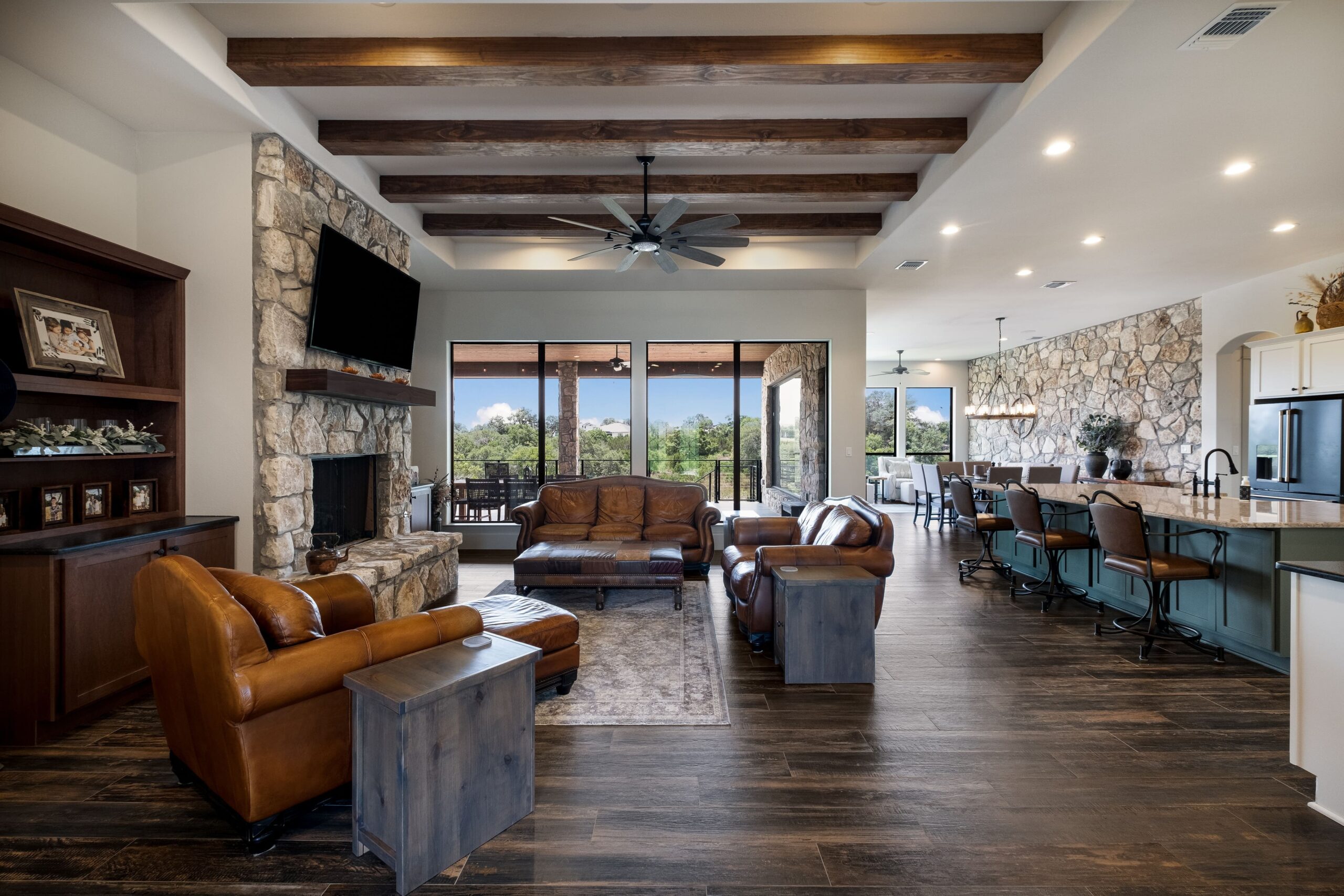
We fell in love with Wimberley years ago — the Square, the river, the pace of it. When we found our lot on the hill above Cypress Creek, we wanted a builder who understood that the home had to feel like part of this community, not imported from somewhere else. Turner built us a home with stone from the region, timber that fits the landscape, and a covered porch that watches the valley fill with fog every morning.
Your Wimberley Home — A Home That Belongs in This Valley
The Blanco River, the cypress trees, and the creative energy of Wimberley are all here. Turner can walk your lot and show you how a custom home can belong in this landscape.